
Exorcism
Once More Unto the Breach

One of the reasons I started this Substack was to “think out loud” about creative projects I hoped, eventually, to bring to publication in one form or another. When I wrote my first post back in July, that meant two projects: the second edition of Thousand Suns and Secrets of sha-Arthan, my long-gestating science-fantasy roleplaying game. Not long afterward, I added a third: one or more anthologies drawn from Grognardia posts. Then, in September, after completing The Shadow Over August series on the blog, I began thinking seriously about a Lovecraftian fantasy RPG, Dream-Quest. Within the space of just a few months, I found myself juggling four active projects.
That’s not necessarily a bad thing. Indeed, one could argue it’s a very good one. I know plenty of creative people who struggle to give shape to their inchoate ideas and would probably be deeply envious of my situation. I’ve rarely had trouble coming up with ideas. My difficulty has always been in seeing those ideas through to completion, especially in a form that can be easily shared with others. Even when I manage that, I often feel I’ve done so in a way that’s less satisfying than I’d hoped, whether to myself, to others, or — frequently — to both.
I’ve talked about this before. It’s a longstanding vice of mine: taking on too much at once and then failing to follow through or else producing something that isn’t as good as it might have been, if only in my own estimation. Lately, these thoughts have been haunting me. For a variety of reasons, I’ve found myself looking back over earlier projects and indulging in all manner of “what if” scenarios. As a rule, I try to avoid that sort of thing, because very little good ever comes of it. The past is the past and there’s no changing it. Why waste time ruminating over the ways you fell short or failed to live up to your own expectations, when that same time could be spent doing the work now, armed with a clearer sense of what went wrong and how to do better?
That’s precisely why I’ve tried, up to this point, to use this Substack as a place to focus on new projects — ideas unburdened by much in the way of baggage and therefore capable of giving me genuine satisfaction as I bring them to life. Secrets of sha-Arthan, for example, is built around a wholly original setting, one I’ve been turning over in my mind for years and refining through more than a decade of refereeing a very successful Empire of the Petal Throne campaign. I truly believe I’ve worked out ways to present a deep, exotic fantasy world that remains approachable for newcomers. All modesty aside, that’s no small accomplishment and it’s one I should be far more intent on seeing through to completion than I have been so far.
The same is true of my other current creative projects. Whether it’s Thousand Suns, Dream-Quest, or the Grognardia anthologies, I ought to be pressing ahead, committing myself to ensuring that at least one of them reaches completion. Instead, my attention keeps skittering from one idea to the next, forever discovering something new to think about rather than something old to finish. It’s frustrating, certainly, but it’s also a familiar pattern, one I’ve long since learned to recognize and, if not entirely accept, at least acknowledge, even when I don’t care for the results.
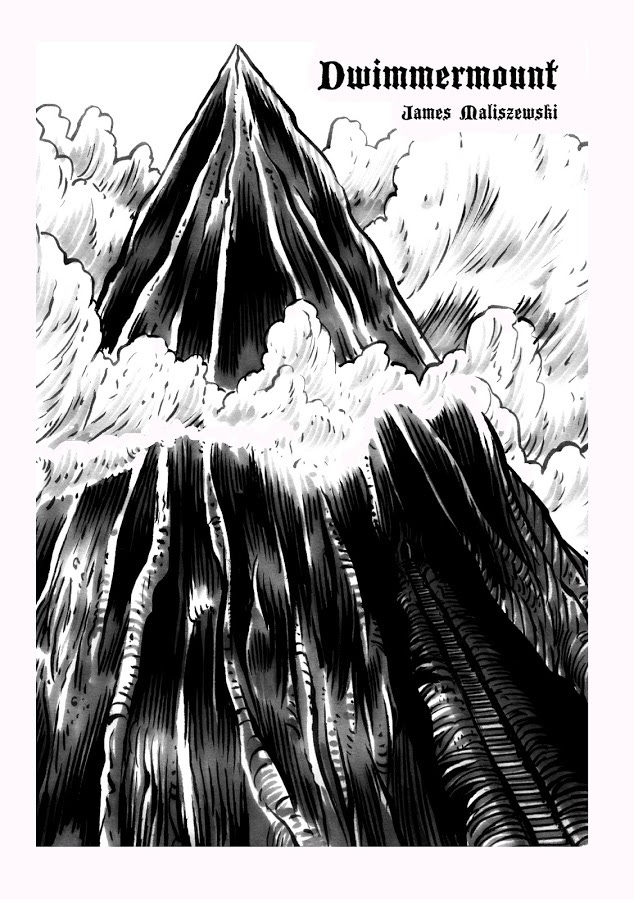
Lately, though, my thoughts have been drifting back to my megadungeon, Dwimmermount. Regular readers of this Substack will already be aware of that fact, though the depth of my current preoccupation may not be immediately obvious. The truth is that, despite having declared Dwimmermount abandoned a few months ago, I can’t seem to stop thinking about it. That’s probably inevitable, given its troubled genesis and the controversies that surrounded it. I retain an immense affection for Dwimmermount, but that affection is tangled up with no small measure of embarrassment over the many ways in which I feel I failed the people who supported the project. Of all the “what if” questions that haunt me, what if I’d done a better job of seeing Dwimmermount through to completion? ranks near the top.
That almost certainly explains why I’ve written several posts about it over the past couple of weeks, both here and at Advanced Grognardia. Some part of me still believes I owe it — to myself and to my supporters — to do right by Dwimmermount, though I honestly don’t know what that would even look like. At this point, it’s a project firmly rooted in the past and, by and large, everyone whose opinion matters most to me has already moved on. I should probably do the same. Shouldn’t I?
Even so, I find myself drawn back to it. I’ve been opening old files of unused material, revisiting unseen illustrations, and mulling over ways to make meaningful use of all of it. More than that, I’ve been searching for a way to lay the ghosts of the past to rest, some method of finally putting Dwimmermount to bed. Like a wound that still twinges now and then, it lingers, a constant reminder of past mistakes. Perhaps that’s useful in itself. Perhaps being reminded of my missteps is what will keep me from repeating them.
But a part of me — a larger part than I had realized — wants to do more than simply remember.
I got to run some of Dwimmermount, and would love to do so again. I can't say where your touch ended, and the finishing polish began. It isn't something I think about. It ended up in my hands, and I was happy with the result, even if you were not entirely satisfied. I hope you can be proud of what came into being, even if you someday revisit it to complete your unique vision of it.
The old Dwimmermount posts remain among my favorite bits of your writing. The final product has always been a bit much for me to digest in pdf. I would really love an ongoing series of designer notes on rooms and levels. Perhaps as part of the room rewrites you’ve been dabbling with.