
Interstellar Currency and Banking
Another Thousand Suns Rabbit Hole

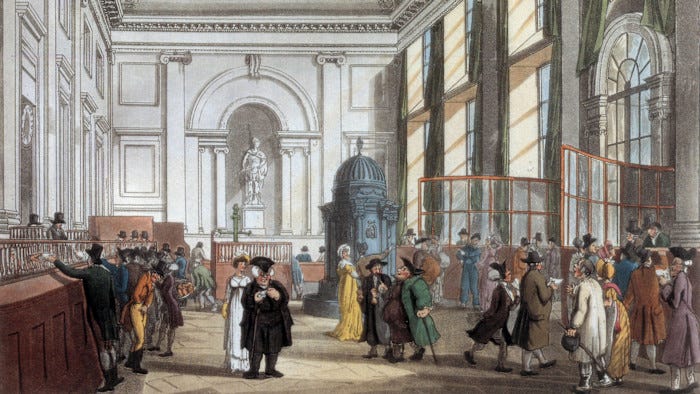
Following on Wednesday’s post about the Nova Kalendario, I’ve been continuing to think about the implications of there being no instantaneous interstellar communications for others aspects of the Thousand Suns setting. I’ve drawn on my knowledge of historical analogs to create a foundation for what follows. I’ve also been inspired by ideas drawn from other science fiction settings, as well as my own ideas. Once again, I’ve probably thought more about this than is strictly necessary, but that’s kind of what I do.
The immense distances separating the worlds of the Thousand Suns mean that neither goods nor information travel quickly between them. Starships may require weeks to cross even a single sector and there is no faster means of communication. As a result, the interstellar economy operates very differently from those of individual worlds. Banking networks, merchant houses, and courier ships carry not only cargo and passengers but also the financial records that allow commerce between the stars to function.
Despite these limitations, trade flourishes throughout human space thanks to a common unit of account known as the sol.
The Sol
The sol is the standard unit of account used across the Thousand Suns. Most interstellar trade, banking, and contracts are denominated in sols. Although many worlds maintain their own local currencies for everyday transactions, these are typically tied to the sol through fluctuating exchange rates. In practice, sols rarely exist as physical currency. Instead, they are recorded as balances in the ledgers maintained by banks and financial institutions.
Interstellar Banks
Commerce between the stars depends on large banking networks that maintain branches on many worlds. These banks record deposits, transfer funds, and provide credit to merchants and travelers.
When an individual deposits money with a bank, the institution records the amount in its ledgers as a balance denominated in sols. The depositor may then access these funds at any branch of that bank or its partners.
Although many smaller institutions exist, most interstellar trade ultimately relies on the guarantees of a handful of large banking houses whose reputations are trusted across human space. These institutions maintain networks of branch offices across multiple sectors, allowing merchants and travelers to conduct business far from their home worlds.
Because information cannot travel faster than starships, each bank branch maintains its own copy of the bank’s financial records. These records are periodically updated when ships arrive carrying encrypted ledger packets from other systems. As a result, the financial records on one world may be several weeks out of date compared to another.
Ledger Updates
Whenever a ship arrives from another system, it typically carries encrypted financial data as part of its cargo. These data packets include:
updated account balances
cleared transactions
commodity price reports
currency exchange rates
interbank settlements
Upon arrival, banks merge these updates with their local ledgers. This process synchronizes the financial system across the interstellar network.
Because ledger updates travel along established shipping routes, most banks operate on a standardized financial calendar tied to the arrival schedules of major courier lines. Worlds located on busy jumpline routes may receive updates frequently, while remote systems in the Marches may wait weeks for the next financial synchronization.
Until such updates arrive, banks must operate on the basis of the most recent information available to them.
Credit and Withdrawals
Financial records may be weeks out of date, which means banks generally allow customers to withdraw funds only up to the amount confirmed by the most recent ledger update. For trusted clients, banks may extend limited credit beyond this amount. Such credit is based on reputation, collateral, or long-standing relationships with the bank. Merchants, corporations, and powerful families often maintain large credit lines that allow them to conduct business even when financial records have not yet fully synchronized.
Financial Latency
Since financial records travel between systems aboard starships, banks in one system may not have the most recent information about accounts held elsewhere. For most ordinary transactions this delay has little effect. However, when a traveler attempts to withdraw a substantial sum in a system where his account has not yet been updated, the bank may require additional verification before authorizing the withdrawal.
Verification Test
Make a Bureaucracy test.
This test represents navigating institutional procedures, presenting proper documentation, and reassuring officials that the transaction is legitimate despite the lack of up-to-date financial records.
Success means the bank authorizes the transaction immediately. Failure means the bank restricts access to part of the funds until the next courier ship arrives carrying updated financial records.
Reputation and Standing
The Game Master may grant a +1 or +2 bonus to the test if the character possesses factors that make the bank more willing to trust him, such as:
membership in a respected organization
noble or corporate status
an established relationship with the bank
a letter of credit from a reputable institution
a strong professional reputation
Likewise, a character known to be unreliable or suspicious may suffer a penalty at the GM’s discretion.
Letters of Credit
For large transactions, merchants commonly use letters of credit issued by reputable banks. A letter of credit is a certified document guaranteeing that the issuing bank will honor a payment up to a specified amount. These instruments allow traders to conduct business across many worlds without transporting large sums of physical wealth. Letters of credit are widely trusted throughout Terran space, particularly when issued by established banking houses.
Financial Couriers
Financial information is among the most valuable cargo carried by interstellar ships. Banking networks, merchant houses, and governments maintain specialized courier services that transport encrypted financial records between worlds. The arrival of a financial courier may cause dramatic shifts in local markets, as banks and merchants update their ledgers and revise prices based on the latest information from distant systems. Because of their importance, such couriers are often well protected—and occasionally the targets of piracy, espionage, or sabotage.
Pensions and Salaries
Individuals receiving pensions, salaries, or other regular payments typically maintain accounts with one of the major interstellar banks. Payments are deposited into the recipient’s account in sols. The funds can then be withdrawn at any branch of the bank, subject to the limits imposed by the most recent ledger update. Travelers moving between systems may therefore find that access to their full balance is temporarily restricted until financial records catch up with them.
Implications for the Setting
The slow movement of financial information shapes the character of the interstellar economy in several ways.
First, merchant banks and courier ships play a vital role in maintaining the flow of trade between worlds. Without them, economic activity across the Thousand Suns would quickly grind to a halt.
Second, information itself has immense value. News of political upheavals, mining strikes, crop failures, or new discoveries can dramatically affect markets. Those who obtain such information first may profit enormously.
Finally, the institutions that manage these financial networks wield considerable influence. Major banking houses, merchant exchanges, and courier lines often maintain operations across many worlds within a sector, giving them economic leverage that can rival that of governments and noble houses.
Control over financial networks can therefore become a point of contention in sector politics. Rival powers may seek to influence banking institutions, disrupt courier routes, or manipulate the flow of economic information in order to gain advantage in the ongoing struggles that shape interstellar affairs.
Implications for Play
For most characters, the banking system functions in a straightforward manner. Funds are deposited with a bank and withdrawn as needed during travel. The sol serves as a convenient unit of account for wages, purchases, and trade.
However, the peculiarities of the interstellar economy can also create opportunities for adventure. Characters might be hired to:
transport sensitive financial data
protect courier ships
investigate fraud or financial espionage
exploit price differences between worlds
recover stolen credit instruments
In the Thousand Suns, money does not simply move through abstract networks. It travels aboard starships, along with the information that keeps the interstellar economy alive.