
Neither Primitive Nor Professional
Rambling Thoughts about the Esthetics of the Old School

Lately, I’ve been a bit distracted by family matters — nothing serious, just the kind of thing that makes it hard to focus — and it’s slowed my progress on a number of projects I’d hoped would be further along by now. Mind you, that’s not exactly new for me. If anything, it’s probably my default state. Still, it’s frustrating to feel like I’m perpetually in a holding pattern while I try to get things moving.
The funny part is that I haven’t been idle. I’ve actually gotten a lot done, even if it doesn’t always translate into something I can share publicly. A good example is my work revising The Cursed Chateau and the accompanying Tellurian Codex. Since the start of the year, I’ve made solid progress on both of them, at least as far as the writing goes. Turning those texts into something I can share (and hopefully sell) is another matter entirely.
As I often joke, my one skill — writing — is probably the least important when it comes to producing saleable RPG material. I can’t draw or make maps, so I have to rely on others for that. Likewise, my ability to lay out a book for publication is primitive at best. When I do try, my natural perfectionism tends to take over. Still, the upside is that these struggles have pushed me to think more seriously about what actually makes a good RPG book from the production side.
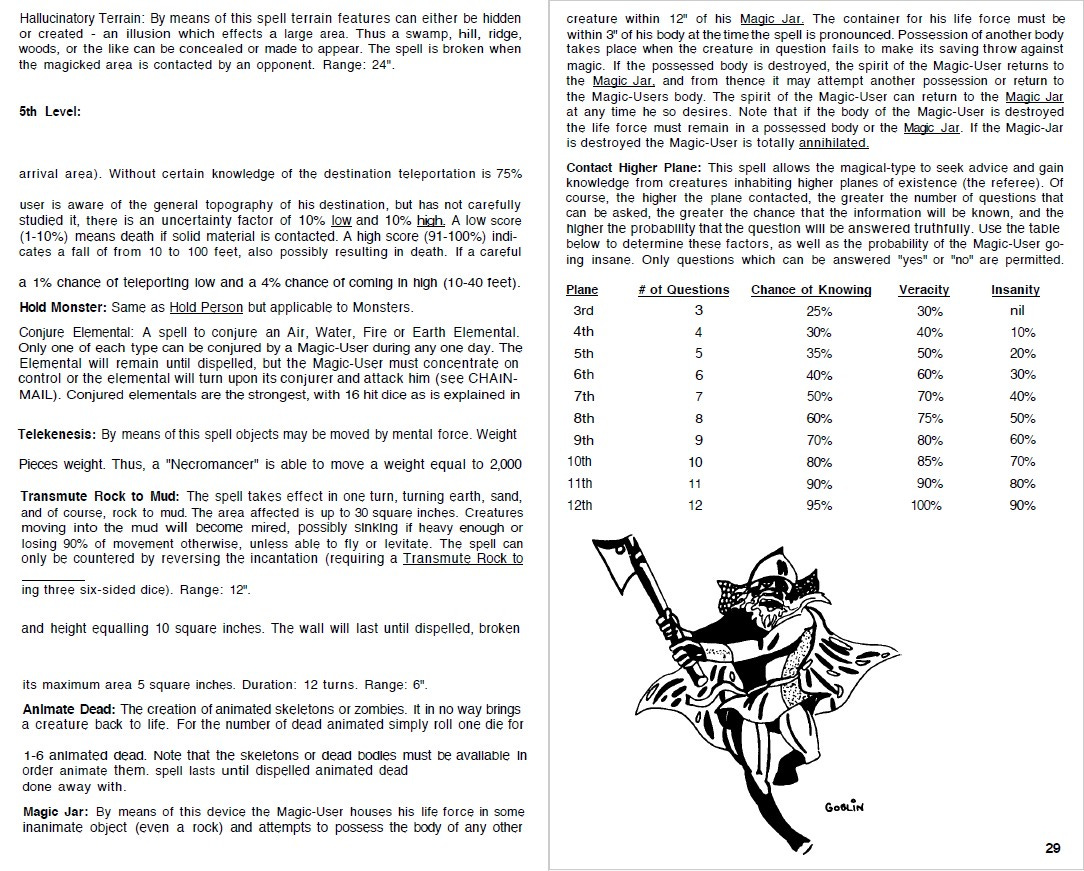
This has led to some interesting discussions with others. In them, I’ve repeatedly noted that RPG products, even on the supposedly old school side of things, have become increasingly slick in their presentation. That includes ‘zines, whose recent resurgence owes a great deal to the renewed appreciation of their 1970s and ’80s antecedents. Those early fanzines were brimming with imagination and creative energy, but they were rarely much to look at. To a large extent, that was due to the technological limitations of the time. Even so, many were slapdash in their layout and graphic design.
That’s not a criticism so much as a statement of fact. Despite the efforts of some old school aficionados to turn the limitations of early RPG products into virtues, I sincerely doubt many fans or publishers from the hobby’s first decade would have rejected modern desktop publishing tools on principle if they’d been available. The look of those formative products was rarely a deliberate esthetic choice; it was a concession to the realities of the era. Most RPG creators simply lacked the money, skills, and technology to make their books look “better,” and that’s really all there is to it.
At the same time, there’s a part of me that’s actively turned off by the polish of roleplaying game books today, even those published by one- or two-person operations. I don’t want my “old school” ‘zines to be full-color or printed on glossy paper. On some level, that feels almost antithetical to what a fanzine is supposed to be. I say this even about many RPG products I genuinely like. Increasingly, too many of them feel overproduced, to the point that it sometimes dampens my enthusiasm. Roleplaying is, to me, an inherently “analog” hobby and production values that lean too hard into the high-end can sometimes feel like they’re missing the point.
Of course, the opposite extreme is no better. I’m not interested in fetishizing the primitiveness of early RPG materials, either. The Little Brown Books of OD&D don’t look the way they do because Gygax and Arneson wanted them to. They look that way because they had no choice, given their limited resources. Having spoken directly to Marc Miller about this, I know for a fact that the original 1977 edition of Traveller looks the way it does because he used the best technology available to GDW at the time, an IBM Selectric II typewriter. I suspect many other publishers would have done the same if they’d had access to comparable tools.
My point is that, while I don’t much care for RPG products that look too good — a nebulous quality, to be sure — I also have little patience for the romanticizing of early roleplaying game aesthetics, as if (in most cases) they were an intentional stylistic stance rather than a practical necessity. I admit there’s some tension here and I’m not entirely sure how to resolve it.
The Old School Renaissance has always been about more than the rules of old RPGs. It’s also about a particular relationship to the hobby, like its do-it-yourself ethos, its intimacy, its rough edges, and its sense of immediacy. A fanzine that looks like a boutique art book may be impressive, but it can also feel oddly impersonal. Such things feel to me more like a product designed to be admired rather than to be used in play and that’s just wrong.
Even so, “authenticity” can become its own kind of performance. Bad layout, illegible type, muddy photocopies, and willfully crude artwork are not inherently virtuous. They don’t make a work more imaginative or more sincere; they just make it harder to read. If the early hobby taught us anything, it’s that creativity thrives under constraints — but that doesn’t mean the constraints themselves deserve worship.
Maybe the trick is not to aim for either “professional” or “primitive,” but for appropriate. A roleplaying book should be clear, usable, and inviting. It should look like it was produced for play, not for display. If so, the most genuinely old school esthetic isn’t “cheap” or “glossy” at all, but simply one that suggests this was made by people who love the hobby for other people who love the hobby, who expect you to do something with it besides admire it.
All of which is a typically longwinded way of saying that I’ve been thinking a lot about this topic lately and I have more to say about it as it relates to my own projects — but I’ll save that for my next post in a few days.
Speaking as someone who did literally cut and pasted the output of phototypesetters and made bromides for offset printing, I can definitely say the invention of desktop publishing changed everything. My first use of a laser printer (Laserwriter I) to make camera-ready copy was a total change of the paradigm. Although POD does mean the idea of a Heartbreaker Fantasy is long gone. You no longer have to mortgage your house to print your work of heart, and then hope that you can then sell enough copies to avoid burning them to stay warm in winter.
Although I do miss cutting stencils for a Gestetner on a typewriter to produce the magazine for the local wargames club. In particular the need to get it right the first time, or retype the entire page (fingernail polish could only do so much to cover such errors). Which is my own personal problem with DTP - the ease of editing means a tendency to continually rewrite the same page again and again to try and get the emphasis you want.
Best of luck with your own projects.
That bit about authenticity, I feel like it could apply to a lot of art forms. There are so many styles that are based on a particular aesthetic, and if you're not careful, the aesthetic package can turn into a coffin.
Back into D&D, it's one reason I really got into Pathfinder back in the day. Even if the system was a bit crunchy, the stories felt fresher than the usual cliches. But that was a while ago and now I'm not sure where I'm going.
Then again, I'm older now and I don't really go into D&D for the same reasons I did when I was a teenager in the 1990s. A lot has changed.