
Refinement
Your Opinions, Please

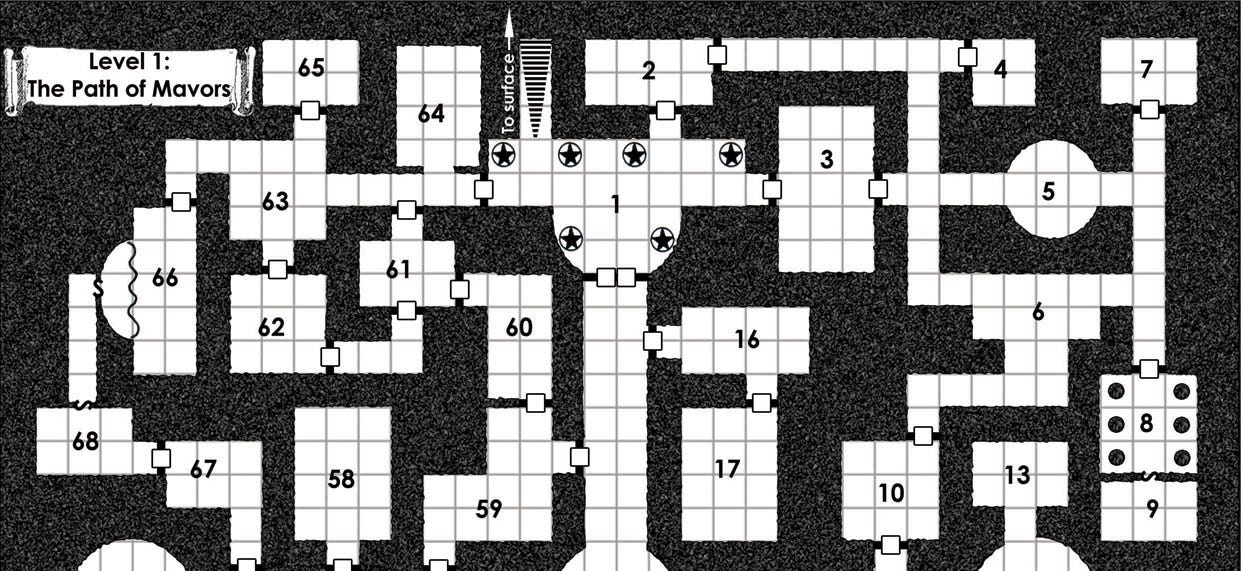
Last week, I asked for your thoughts on three different ways of presenting a dungeon room for use by a referee. The responses were, by and large, thoughtful and generous, with the third option emerging as the clear favorite, albeit with occasional caveats.
I should be candid: I’m not entirely convinced that the third option is the best approach and there are several reasons for my hesitation. I’ll explore those concerns in more detail in a future post. For now, though, I’d like to continue refining that option, informed both by the feedback you shared and by my own evolving thoughts on the matter.
To that end, I’d very much appreciate your impressions of this revised version of the third option. Before diving in, however, I’d like to ask you to keep a couple of things in mind.
First — and most importantly — this particular request for feedback is aimed at improving this specific style of presentation, not at debating whether the style itself is worthwhile. I fully understand that it won’t appeal to everyone and that’s perfectly fine. If this approach simply isn’t to your taste, please feel no obligation to comment. Your preferences are valid, even if they’re not what I’m focusing on right now.
Second, this presentation is meant to be used by a referee during play. My primary goal is to make it as clear, practical, and helpful at the table as possible. Comments that suggest ways to improve its usability in that context are especially welcome.
There will be opportunities later to step back and offer broader or more critical perspectives on the overall approach. For the moment, though, I’m concentrating on making this version the best it can be.
With that, here’s the latest refinement of the room. Thank you in advance for your comments.
Entrance (Six Statues)
First Impressions:
Five male statues in archaic Thulian dress, all with identical bearded heads.
One stern female statue, separate from the rest.
Details:
Characters with religious knowledge recognize the heads as Turms Termax.
Heads on the male statues are replacements; a successful open doors check removes them.
Female figure is Sarana, lover of Turms, who vanished before his apotheosis.
Exits (4):
North to Guardroom (2)
East to Reception Hall (3)
South to corridor.
West to corridor.
I think this format would struggle with diverse points of interest that can't be easily grouped together. It works in a room full of statues, but what about a room with a well, graffiti on the south wall, and a discarded bird cage?
It's hard to fully address how well this room does its job because I'm unsure if you would have an initial section where you are describing basic dungeon construction. If not, I'd really want to know things like what these statues are made out of. Your initial description in the prior post also made it a bit more clear that it would be obvious to a person with the right background that these statues originally depicted individuals that weren't Turms Termax.
Personally, I'd tend towards including clues in the actual construction of the statues that these replacements have occurred. A difference in the color or texture of heads versus the rest of the body. This would presumably be even more pronounced with Sarana, whose entire statue would presumably have been constructed at the same time as the heads were replaced.
Pages references would also be useful. Like knowing the page where Turms Termax is discussed in case I have forgotten the finer details, or if there is another location where the removable heads might be a factor.
Now, as to what needs to be listed since the map displays certain information. I actually disagree with some others commenting in that I like when exits are listed in the key because I personally always forget to tell my players exits and the reminder within the key is quite helpful. I would also add that including directional arrows in addition to cardinal directions can be useful for reducing cognitive load with a price paid of only 3 characters each. Such things being listed in the key is especially useful if you don't include a mini-map on each spread that you can reference when also referencing the key.
Speaking of things being shown on the map, one thing I am unsure of based on your example key is where Sarana's statue is. I am assuming it is the one in the northeast corner, but it isn't entirely clear from the text.
Anyway, food for thought.
I like the separation of first impressions and details. The exits is an excellent touch with the directions and connections. Maybe the type of exit? Door, archway, secret, concealed, etc.?