
The Curse Grows
Improving on a Classic

I mentioned last week that I am in the midst of putting together a new version of my haunted house adventure, The Cursed Chateau. There are a number of reasons why I’m doing this, but the chief among them is that, having taken stock of the comments and criticisms of others (as well as my own experiences refereeing it since 2008), I think I can improve it in a number of ways.
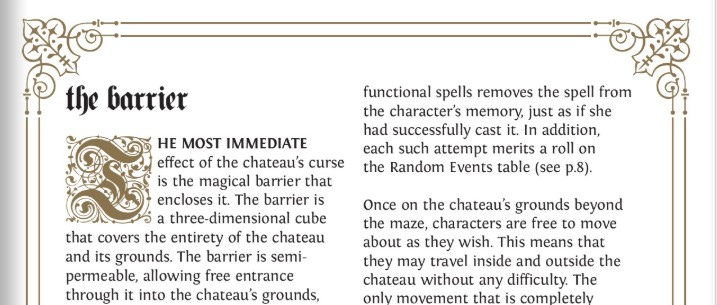
Let me give you an idea of just one small but significant change I plan to make in the new version. In all previous versions of the adventure, the characters become trapped in the chateau by means of an invisible magical barrier that prevents their escape until they break the titular curse. Here’s how the barrier is described in the 2016 version (apologies for the pXX references):
The Barrier
The most immediate effect of the chateau’s curse is the magical barrier that encloses it. The barrier is a three-dimensional cube that covers the entirety of the chateau and its grounds. The barrier is semi-permeable, allowing free entrance into the chateau’s grounds, but preventing all egress (by any means, whether physical or magical) until the curse is lifted (see pXX). This means that it neutralizes the functioning of any spell that would enable movement beyond the barrier (though Jourdain enjoys seeing the characters attempt to cast them, see pXX). Using these guidelines, the referee is the final arbiter of what spells are thus prohibited from use. Attempting to cast any non-functional spells removes the spell from the character’s memory, just as if he had successfully cast it. In addition, each such attempt merits a roll on the Random Events Table (see pXX).
Once on the chateau’s grounds beyond the barrier, characters are free to move about as they wish within it. This means that they travel from the maze to the grounds to the chateau and back again without any difficulty. The only movement that is completely prohibited is movement outside the barrier. Characters attempting to do so by, for example, climbing over the wall surrounding the grounds or walking out of the hedge maze will discover a hard but invisible wall of magical energy. Touching this wall does no harm to the character, but hitting it with any ordinary implement, including weapons, results in its being shattered (and a roll on the Random Events table.
Strictly speaking, there’s nothing wrong with the barrier as written. It’s a time-honored, if heavy-handed, obstacle intended to ensure the characters have to deal with the problem at hand rather than simply fleeing the chateau entirely. At the same time, I’ve learned, both personally and from others, that not every player group likes it and indeed some find it too “gamey” to the point it takes them out of the adventure.
I think that’s a fair criticism, which is why, in the new version, I’ve opted for a different approach. It’s not substantively different; the characters are still trapped on the chateau’s grounds without any easy means of escape. However, the new approach is less obvious and — I hope — more immersive. At the very least, it’s intended to be more like something one might encounter in a haunted house story like those that inspired The Cursed Chateau. Here it is:
The Turning Path
The most immediate sign of the chateau’s curse is not a wall or a ward, but a treacherous twist in Space itself. Any character who attempts to leave, whether by scaling the outer walls, cutting through the hedge maze, or invoking magic, simply ends up where he started. One moment, he’s pushing open a gate or forcing his way through brambles; the next, he’s back among his companions, boots on the same stones as before.
There is no flash of light, no wrenching lurch through the ether. The world does not ripple or glow. He is just… back—as if the universe blinked and quietly put him in his place. The effect is baffling and deeply unnerving. Most characters will try again and again before the truth sinks in: there is no way out.
Magic fares no better. Spells meant to carry the caster beyond the grounds, like fly, dimension door, teleport, and the like, seem to function perfectly, only to betray the caster at the last instant. From the caster’s point of view, the spell works—right up until it drops him back where he began. The referee decides which spells are thwarted, guided by common sense and the malign spirit of the chateau’s curse. Each thwarted spell is lost from memory as if properly cast and every such attempt calls for a roll on the Random Events Table (see pXX), to the unseen delight of Lord Jourdain.
Inside the chateau’s domain, movement is unhindered. Characters may roam freely between the gardens, the maze, and the chateau’s echoing halls. Doors open, paths wind where they should, and nothing bars their passage—so long as they do not try to leave.
There is no invisible wall to hammer against, no unseen force to probe with steel or spell. The curse does not block: it bends. Every escape route folds back on itself, sly and subtle, never in the same way twice. To the trapped, it feels less like a prison and more like a cruel trick of fate, a labyrinth without walls that forever steers them back into its waiting jaws.
Is this an actual improvement? I think so, but I’m admittedly biased. I’d love to know what you think in the comments.
I quite like it - you are right, is in form the same thing that you had written, but in function is it much more immersive and perverse. I am really looking forward to using this and putting my own twist on it in my campaign (presuming the adventurers decide to take the bait).
A more thoughtful solution, let me warn that you'll find for sure the rule-lawyer (with a phd in astrophysics) who will ask you some weird questions about possible options involving the space-matter boundaries...
If I may, I have a second question for you, it seems nasty (but it is not in its purpose...): do you consider this adventure like its predecessor, Caste Amber, a railroad module due to the presence of the curse (or fog for X2)? This is a long-life question you made me arise from the past and to my eyes it is not yet answered! Thanks and ciaoo