
The Four Worlds
An Incomplete Tour of the Cosmos

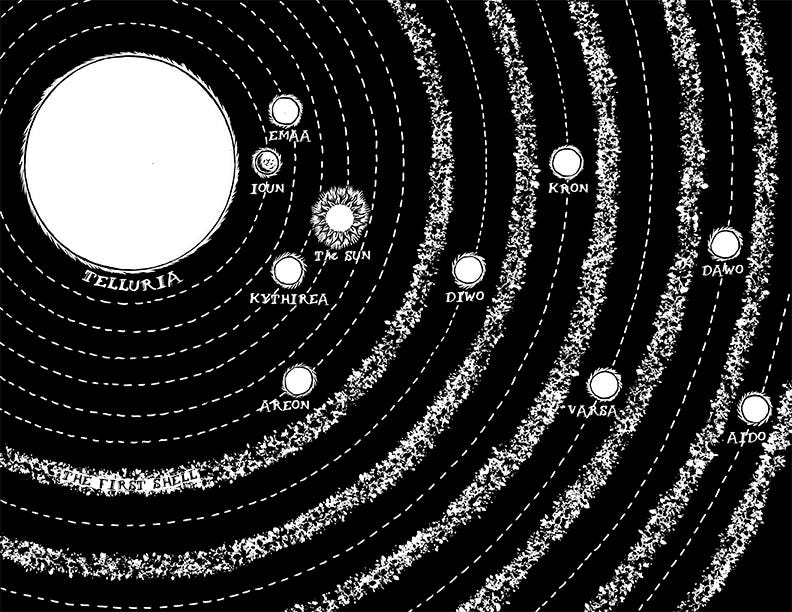
Though the heavens are crowded with many planets beyond, Tellurian sages agree that four alone truly matter. These are Kythirea, Telluria, Ioun, and Areon — the so-called Four Worlds. For untold millennia, they have been bound together by trade and war, colonization and conquest, alliance and betrayal. Their shared history is written in ruined cities, shattered empires, and ancient crimes best left forgotten.
All four worlds are further united by Dwimmermount. At the height of its power, the mountain fortress housed numerous active interplanetary portals and maintained hangars for astral vessels that crossed the gulfs between worlds. Any Tellurian campaign inevitably touches the wider cosmos it once commanded. What follows is only an outline meant to guide the referee. Should adventurers set foot upon these worlds, the material here should be expanded and embellished as needed.
The Astral Plane
The Four Worlds drift within the vast reaches of the Astral Plane, also called Astral Space or simply Space. This endless void is permeated by ether, a subtle, luminous substance that is neither wholly material nor wholly immaterial. Ether flows like a liquid when pressed by solid matter and living flesh, yet resists all attempts to measure or contain it.
Alchemists and magicians identify ether as the long-postulated fifth element —quintessence — and the evidence is persuasive. When ether is drawn down to a world and thickened by local laws of reality, it takes on a more tangible form: a silvery-black, liquid metal known as azoth.
Specially constructed vessels can sail the ether much as ships cross water. Some rare individuals can even swim through it, though such journeys are slow, exhausting, and perilous. Scattered throughout Astral Space are countless lesser bodies — asteroids, planetoids, and drifting fragments — not large enough to be called worlds. Many are inhabited, either by native beings of Space or by exiles, castaways, and colonists from elsewhere.
Foremost among these inhabitants are the Astral Reavers: Men who came to Space centuries ago and were warped by prolonged exposure to ether. Now twisted in body and soul, they roam the Astral Plane as marauders and willing servants of Chaos.
Kythirea
Kythirea, the third world in the heavens, is known everywhere as the Green Planet. Seen from Telluria, it appears at dawn and dusk as a bright green star hovering just above the horizon. The name is no poetic exaggeration. Kythirea is smothered in steaming jungles, colossal forests, and riotous plant life. In this it stands as the living mirror of Areon, for the Green Planet teems with life in every form imaginable, including its own races of Men.
In ages past, travel between Telluria and Kythirea was common. Many plants and beasts now thought native to Telluria were first brought from the Green Planet by sorcerers and scholar-kings seeking useful curiosities. Both the Great Ancients and the Eld walked Kythirea’s jungles, leaving behind countless ruins now choked by vines and swallowed by the earth. Many of these structures were built to extract azoth from the planet itself. The native peoples resisted this exploitation fiercely and their resistance almost certainly contributed to the eventual expulsion of the off-world powers.
As a result, Kythirea is today the most isolated of the Four Worlds. Its inhabitants are openly hostile to outsiders and quick to violence. The two dominant peoples are the lizard men and the green-skinned Men known simply as Kythireans. Kythirean lizard men bear little resemblance to their Tellurian cousins, possessing highly developed cultures and powerful magical traditions. The Kythireans themselves are equally advanced and may be distantly related to the Great Ancients or the Eld. Unlike either, however, they are an entirely female race who reproduce through arcane means.
Ioun
Ioun, which occupies the first orbit of the heavens, is Telluria’s sole natural satellite and is most often called simply the Moon. Ioun forever turns one face toward Telluria — the Light Side. Its far hemisphere, the Dark Side, is never visible from below.
Both sides of the Moon are scarred with immense craters, the legacy of ancient mining operations. Ioun is rich in magical stones called ioun stones and both the Great Ancients and the Eld poured vast resources into extracting them. Their efforts were so thorough that ioun stones are now exceedingly rare.
The Light Side is governed by Law, the Dark Side by Chaos. Magic — and reality itself— behaves differently on each hemisphere and visitors who are not properly attuned beforehand risk dire consequences. Fortunately, most activity on Ioun takes place beneath the surface, where neither Law nor Chaos holds absolute dominion.
Here dwell the Moon’s native inhabitants, most notably the insectoid Iounians. Once, the Iounians ruled the entire Moon. They were driven underground by the Great Ancients and enslaved as miners, a practice continued by the Eld. This history has left them bitter, xenophobic, and violently hostile to intruders. Rumors persist that some Iounians now dwell on the Dark Side, consorting with demons for unknown and sinister purposes.
Telluria
Telluria is the scholarly name for the world, though almost no one uses it. To its inhabitants, it is simply the World, as if no other could possibly exist. Whether by accident or design, Telluria is the most densely and diversely populated of the Four Worlds.
It is widely believed to be the birthplace of the Great Ancients, the Eld, and —according to some traditions — the Kythireans as well. Stranger still, all other worlds and planets revolve around Telluria, lending credence to the belief that it occupies a unique place in the cosmos.
During the age of the Great Ancients, Telluria was fully explored and settled. In the long centuries following their fall and that of the Eld who succeeded them, vast swaths of knowledge have been lost. The kingdoms of Men that rose afterward are scattered and isolated, often ignorant of one another’s existence. Ruins lie everywhere, mute testimony that Telluria was once a far more advanced and unified world than it is today.
Areon
Areon, the fifth world in the heavens, is known everywhere as the Red Planet, both for its ruddy glow and its long, blood-soaked history. In earlier ages, travel and trade with Areon were common, particularly during the height of the Eldritch Empire, whose capital — the darkly beautiful city of Sytor Arra — stood upon its surface.
When the Eld were overthrown by the Thulians, most of the permanent portals to Areon were destroyed and all contact with the Red Planet was officially forbidden. This prohibition did little to deter bold sages, heretics, and seekers of forbidden knowledge, and secret routes to Areon have existed ever since, even after the fall of the Thulians themselves.
Areon is often called the “home” of the Eld, but, in truth, it was their place of exile. Driven from Telluria, they fled to the Red Planet and built their empire anew. Over time, that empire fractured into dozens of squabbling successor states, many no larger than a single city. This collapse freed countless slave races, including Men, some of whom now rule petty kingdoms of their own. Unfortunately for visitors, these former slaves have adopted many Eldritch customs and are no more welcoming than the Red Elves themselves.
The Eld relied heavily on bizarre and Chaotic sorcery and such magic remains common on Areon. Their infamous dealings with demons have left a lasting stain upon the planet. Indeed, persistent rumors claim that several demon lords now rule domains on Areon itself, preferring it to the Demon Worlds of the Void (Diwo, Kron, Varsa, Dawo, and Aido). If true, this alone explains the enduring fear and prejudice surrounding any commerce with the Red Planet.
This is really cool! What's next?
Great post, I dig it!