
The High Struggle
A Breakthrough for Thousand Suns 2e

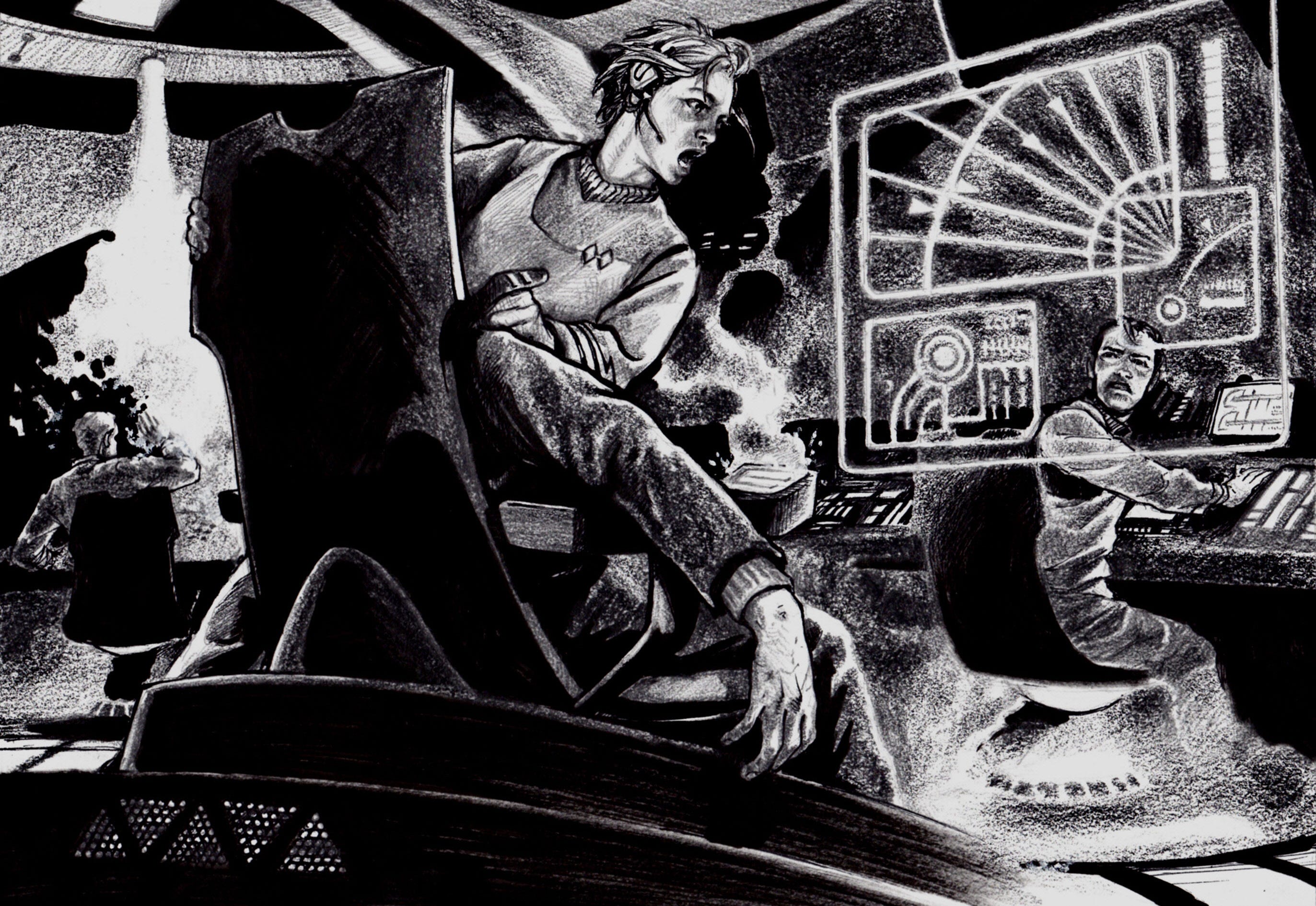
High Struggle (Tera Lingvo: La Alta Lukto)
Encyclopedia Galactica, 7th Revised Edition (484)High Struggle is the conventional designation for the enduring contest among the sovereign powers of the Thousand Suns for influence, security, and ascendancy. Though intermittently expressed in open warfare, it is more commonly conducted through diplomacy, economic pressure, proxy conflict, exploratory expansion, and the calculated extension of protection beyond recognized borders.
Distinguished from limited wars or commercial rivalries, the High Struggle is civilizational in scope and generational in duration. Its purpose is not merely victory in battle but the shaping of the interstellar order through the alignment of trade routes, the direction of frontier settlement, the allegiance of emergent worlds, and the definition of legitimacy. The adjective “high” refers both to the scale of its consequences and to the elevated authorities, such as heads of state, admirals, ministers, and megacorporate directors, by whom it is chiefly directed.
Historians differ as to whether the High Struggle began with First Contact or only after the Wars of Independence ended the illusion of a unified Terran polity. It is generally agreed, however, that so long as sovereignty remains divided and the frontier unsettled, the High Struggle will endure.
Since I began serious work on the second edition of Thousand Suns, the most bedeviling question has been how to distinguish it from the crowded field of science fiction roleplaying games. It’s a small, self-published RPG competing against decades-old SF RPGs and lavishly supported lines. Simply being “good” isn’t enough. It has to be immediately and unmistakably clear what Thousand Suns does that other science fiction roleplaying games do not.
For a long time, I’ve struggled to articulate that difference. The game has always had a distinct tone and a clear set of literary inspirations, but tone alone is difficult to communicate through bullet points or summaries of game mechanics. Only recently did I recognize that the answer had been present all along, quietly shaping my design of the game since its inception: the High Struggle.
Though I’ve never before used the term, the High Struggle is, in fact, a foundational element of Thousand Suns. It represents the ongoing contest between powerful factions— noble houses, religious movements, mercantile combines, secret societies, planetary governments, alien species — for influence, survival, and dominance across the Thousand Suns. The High Struggle is thus the engine of history within the setting.
Its roots are both literary and historical. On the science fiction side, many classic writers of the genre, H. Beam Piper being a prime example, were deeply concerned with the rise and fall of empires, the cyclical nature of civilization, and the way individuals are shaped by vast historical forces. Piper’s future histories are not static backdrops but dynamic tapestries of political and economic transformation.
On the historical side stands the 19th-century “Great Game,” the geopolitical rivalry between the British and Russian Empires for dominance in Central Asia. The phrase captures the idea of history as a contest consisting not merely of warfare, but also of maneuvering, intrigue, commerce, espionage, and influence. The High Struggle takes this concept and scales it to the galactic level.
What Makes This Different?
Factions and factions are not new to roleplaying games. However, few make factional conflict a primary mode of play. In most RPGs, factions are background elements, serving as patrons or antagonists who facilitate adventures, while the focus remains squarely on the player characters as independent operators. The larger political landscape may exist, but it does not usually move unless the Game Master intentionally pushes it.
What I am envisioning for Thousand Suns, by contrast, is that High Struggle moves constantly. Rather than being a mere background element, it’s a structured, procedural system that models the ambitions and actions of great powers between adventures. Governments expand their influence. Religions spread their messages. Megacorporations manipulate markets. Secret societies attempt quiet coups. Worlds rebel. Alliances fracture.
The High Struggle provides each major power with resources, goals, and actionable options. Between sessions (or at defined intervals), these factions take turns acting. They maneuver, invest, sabotage, consolidate, and sometimes clash openly. Their successes and failures alter the political map. The GM does not need to invent every shift by fiat, because the system is designed to produce outcomes. The result is a living political ecology that gives both the GM and the players a “big picture” of what’s happening in a certain region of space.
Imperial Science Fiction, Made Concrete
Thousand Suns is explicitly a game of “imperial science fiction.” When I chose that subtitle, I did so not merely to galactic empires and massive star fleets. I did so because I was interested in science fiction stories about the following:
The maintenance (or collapse) of interstellar order
The tension between center and periphery
The burden of authority
The interplay of tradition, economics, religion, and force
In many RPGs, “imperial” is little more than an esthetic. In Thousand Suns, I want it to mean something more concrete, something that can be used to create both engaging adventure scenarios and memorable campaigns. Ideally, the High Struggle will give mechanical expression to imperial science fiction, ensuring that:
Interstellar states fragment if neglected.
Ambitious groups can overreach and fall.
Political movements can destabilize governments.
Peripheral worlds can become flashpoints.
Great powers can be hollowed out from within.
Because factions act according to defined capacities and constraints, the campaign’s setting evolves in ways that feel organic rather than scripted. The Game Master is no longer solely responsible for inventing galactic history, as the system helps generate it. Even better, the players can get involved, too, taking on the roles of a faction, aiding the GM in creating the setting’s evolving history.
Where the Player Characters Fit
With all this said, Thousand Suns is still very much a traditional roleplaying game with a focus on the player characters. What the High Struggle is intended to do is establishe the macro-level conflicts of the setting. Player characters operate within (and sometimes across) those conflicts. They may serve a noble house, belong to an organization, act as agents of a megacorp, or even attempt to remain independent.
Whatever they choose, their actions can still matter because the High Struggle provides additional context. For example, when they secure a trade deal for a megacorp, it shifts factional leverage within a sector. When they expose corruption in the colonial administration, it weakens it. When they fail to prevent a rebellion, that rebellion does not simply vanish at the end of the adventure but instead alters the balance of power.
Ideally — if my design works as intended — the actions of the player characters and the motion of the High Struggle will work together to create a richer, more meaningful, more adventuresome campaign reminiscent of the best stories of classic SF.
A Different Kind of Campaign
I genuinely believe this approach gives Thousand Suns a clear and compelling identity among science fiction RPGs. My goal is not simply to provide a setting in which adventures occur, but a framework in which history itself is in motion, where both players and Game Master take part in shaping the unfolding story of a far-future civilization. A Thousand Suns campaign should feel less like a series of disconnected episodes and more like a chronicle of an interstellar society under strain, tested by ambition, faith, greed, loyalty, and hubris.
The High Struggle ensures that the galaxy is neither static nor comfortably predictable. Great events do not wait for the player characters to involve themselves. Even if the characters stand aside, history advances. However, if do they choose to act and act boldly, their decisions can redirect the course of that history. They may strengthen a faltering house, topple a rising power, ignite a rebellion, or preserve an empire teetering on the brink.
From the very beginning, this was the promise of Thousand Suns. I wanted a roleplaying game about the rise and fall of interstellar empires and the sapient being who endure those turbulent ages. I wanted imperial science fiction not as mere esthetic, but as an animating principle. I wanted its grand themes to generate concrete pressures, meaningful choices, and unforgettable adventures. The High Struggle is my attempt to make that vision playable.
In an upcoming post, I’ll delve into the specifics of how the system works — or at least how I intend it to work. Shortly thereafter, I plan to release a playtest document so others can examine it, experiment with it, and, I hope, put it through its paces. I’ll likely conduct some playtesting of my own on the Advanced Grognardia Discord server as well.
Because this system is meant to be central to the new edition of Thousand Suns, it must be clear, usable, and, above all, fun. That means testing, refinement, and feedback. If the High Struggle is to fulfill its promise, it will do so with your help.
More soon!
This sounds completely awesome...
I have no idea how it's intended to work, but I imagine it as something like random events (maybe a set of tables) that occur between sessions that inform players what the new local/regional/galactic situation is? I'd be curious to see what effect player actions might have on things or how/if that can even be accounted for.
Like say there's some sort of trade dispute that's messing up shipping lanes in the area and everything has ground to a halt. The players go to the place, do a thing, and solve the crisis, which somehow benefits the faction they've been sent by. Does that somehow feed into whatever the next development is in between sessions or does it just end up being some other new faction development independent of that? Obviously the GM can just say, "Because you did this, this happens", but I wasn't sure if this High Struggle idea does that on its own.
Really interested in the idea though. It vaguely reminds me of something I saw in Dungeon World I think, or at least that's how the GM ran it, with various faction clocks winding down and other factions kind of acting independently towards some sort of goals in the background of the campaign.