
The Need for Speed
How Fast is Too Fast?

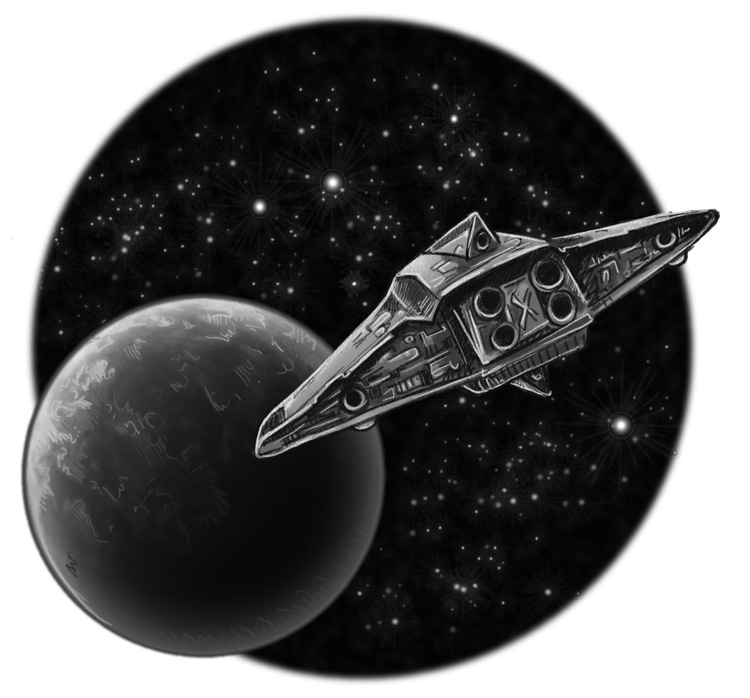
When I first began work on Thousand Suns back in 2007 or thereabouts, there were a lot of specific things I wanted to include—or exclude—from the game in order to evoke a particular type of science fiction literature. One of those things was the idea that space is vast and that, even in a technologically advanced society, traveling from one region of space to another is slow.
I wasn’t interested in the typical space opera trope of being able to zip across the galaxy in a matter of minutes. That’s something that’s always bothered me about most cinematic science fiction. Consider Star Trek as an example. The USS Enterprise is supposed to be out on the frontier of explored space, going “where no man has gone before.” That implies, at least to me, that they’re far away and that traveling there should take significant time. I’m sure that’s what the show’s writers wanted to convey, but the needs of weekly episodic television more or less demand that the Enterprise and her crew are almost never far from a Federation outpost or colony, thereby limiting any sense of scale.
That’s something I very much wanted for Thousand Suns: a sense of scale. Obviously, the moment you introduce faster-than-light travel into a setting, you’re already diminishing that scale, at least a little. However, I think there’s a real difference between a sci-fi setting where you can traversing multiple star systems in minutes or hours and one where it takes days or weeks to do so. (I think it also matters whether or not FTL communications exist—another aspect of Star Trek that, in my opinion, weakens its original premise.)
This is precisely why, when creating Thousand Suns, I was adamant that interstellar travel would be slow and noticeably so. Just how slow, though, was something I didn’t have any strong opinions, especially since the literary science fiction to which I looked for inspiration offered a variety of options. Asimov’s Foundation series, whose stories encompass nearly the entire Milky Way galaxy, postulates FTL travel measured in days. Meanwhile, Niven’s Known Space series postulates slightly longer travel times, measured more in weeks. There’s also the Traveller RPG, which I dearly love, whose jump drive operates on an invariably one-week time frame.
Consequently, I had a lot of range from which to choose. In the 2008 and 2011 versions of the game, I went with a variable time frame, ranging from 1 to 12 weeks. The 1 to 12 range was based on the fact that the game uses 12-sided dice. Using weeks was intended to ensure the pace of movement was indeed slow, since the upper end of the range—12 weeks—was the equivalent of three months or one-quarter of a standard Terran year.
As I work on the second edition of the game and develop its setting a bit further, I’ve started to question my original decision. I remain committed to slow travel between worlds, but I wonder whether weeks is the proper interval. A three-month journey is a very long one within the context of a RPG, especially when a ship in transit is effectively cut off from the larger universe while doing so. Likewise, without even faster communications, the ability of an interstellar government—or even culture—to maintain any cohesion is severely curtailed at that level of distance.
That’s not what I want, hence my thought that maybe, in the second edition, I’ll make the interval days rather than weeks. Traveling 1 to 12 days between star systems is still slow by the standards of science fiction, even if it’s, of course, much faster than any proposed real-world means of traversing interstellar distances. The change, if I opt for it, would have ripple effects in other parts of both the setting and the rules, but none that I think would be detrimental to my goals. I’m still pondering the matter, though, so I may well change my mind.
What are your thoughts on this? I’m curious to know what others think about the matter, both more generally with regards to science fiction and specifically about Thousand Suns.
I've used days instead of weeks since the outset. In order to get a goodly number of sectors between the edge of the empire/federation and its capital, I use the arbitrary figure of one year travel time in one direction max. To me it feels roughly analogous to the Age of Sail in the 1700s-ish. Any farther than that and the span of control simply becomes too great.
If you look at Limzano Sector in the rule book and calculate travel times you'll find it takes months to years to cross it. As an example, Ulmo to Oshan, requiring only 8 jumps, takes 47 weeks to accomplish; Ulmo to Magha, the longest trip from South to North as it were, is 82 weeks, almost two years. And keep in mind that's doing nothing but travelling. I think logically what you'd find are clumps of polities strung along the jump routes. (Which is fun in its own way but it's not congruent with the intent of the game).
Just my opinion.
I have zero experience with SF games unless you count Gamma World, not out of any prejudice so much as habit. So I may be making suggestions that are already standard in interstellar games. But I agree with Greg that the Age of Sail is a good place to look for inspiration. I mean, Gene Roddenberry did. And you already have variable times of travel, much like ships dependent on currents, wind speed and wind direction, so it seems like a good fit. (I don't know if you already have an in-universe reason for the variability, but if you don't, I have thoughts.)
It also depends on what role travel plays in your game. If communications can outrun travel, you can know something is happening, but your response is delayed. If travel outruns communications (which is very Age of Sail), then you aren't even really able to call for help; letters travel faster than radio. (Of course, if that is the case, it raises the question of why you aren't sending messages by "carrier pigeon" FTL drones, which is something you need to consider.)
But the meta question really is, how long do you want it to take to send for help, or go get help? If travel and communication is slow enough, then the players are always on their own; there is no utility at that point for making it longer, other than aesthetics. If you want help to be a possibility, either because the players ask for it, or because you want the players to have a shot at responding in time, then you need to tailor travel and communication speeds to allow those scenarios.
So I guess the question is, how long in-universe does it take for a scenario to play out? And how much prep can be done by the PCs while in transit? Will there be delays to resupply or obtain special equipment before they have to leave? Is any of that even a part of your game? Keeping in mind that you can always manufacture reasons for delays in communications, but if you make communications or travel too slow, you remove the option of creating scenarios where there is time to respond. So perhaps err on the side of too fast, rather than too slow?
If travel itself is risky, then the system should probably be a bit more complex, because subjecting players to risk without choice isn't really all that fair, or interesting. So I think if travel itself is risky, there should be ways to manage that risk. Maybe there are routes that are fast but but riskier, or slow but safer.
Keep in mind that the visual evidence of where a star is just shows you where the star used to be years/decades/centuries ago -- even before you consider how the gravity of seen and unseen bodies between you and the star might have bent the light. Even if someone has been there and back, since everything is in motion, still travelling away from the big bang, all that person can tell you is where the star used to be, its speed and its bearing. So it wouldn't be a leap to suggest that going directly through deep space, instead of taking an indirect route by system-hopping, could carry a greater chance of getting lost.
System hopping between friendly polities is safer and means you have access to supplies and repairs, but it may be very indirect. Hopping to unfriendly systems, or unpopulated/patrolled systems, might save time, but it carries the risk of encounters with unfriendly navies or pirates. Deep space travel is very direct but carries a greater risk of getting lost, or travelling into uncharted hazards, plus who knows what is out there?
Just my $0.02.