
The Terran State
Whether Federation or Empire, Some Truths Remain

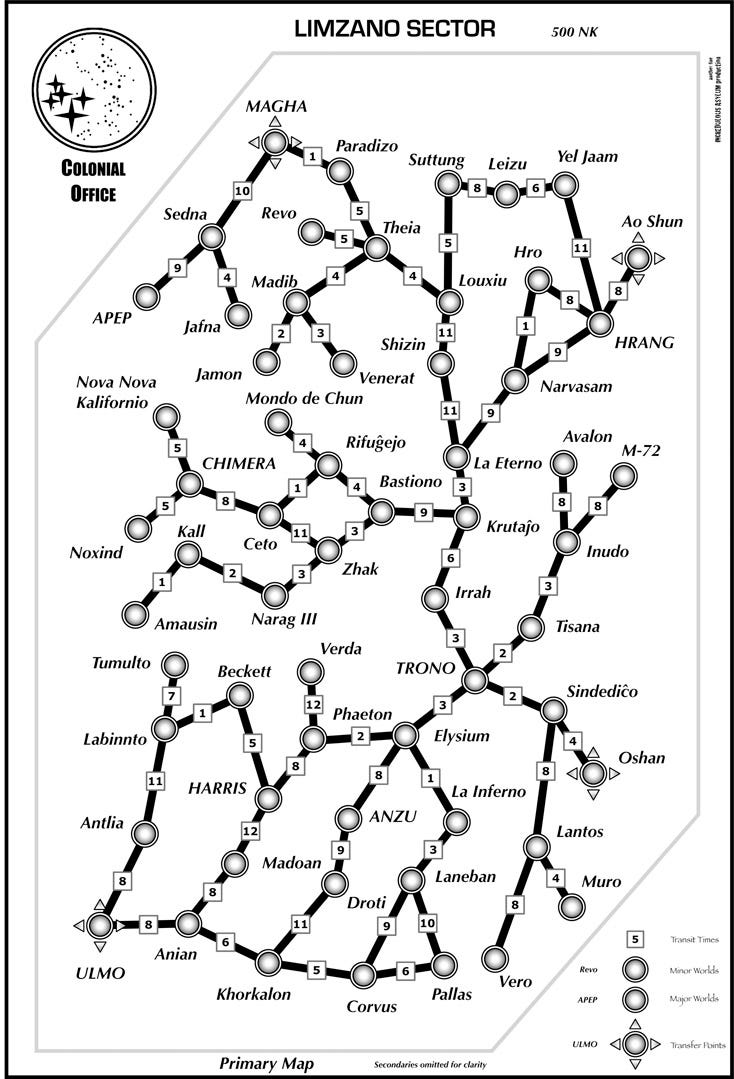
When I first conceived of Thousand Suns, I wanted it to be a toolkit for Game Masters wishing to build their own imperial science fiction settings. Even so, I quickly realized that I still needed to provide some sort of foundation on which they could do so. That was the origin of the game’s “meta-setting,” which left many specific details vague or even undescribed for the benefit of individual creativity. While I still like that approach in principle, I’ve gotten some feedback that suggests Thousand Suns might benefit from a more concrete and well defined setting.
I haven’t yet made up my mind on this matter yet, so I appreciate any comments you might have on the matter. For the moment, as I work on the draft texts of second edition (some of which are already available), I'm sticking with some degree of vagueness when it comes to things like the interstellar government of the Thousand Suns. As in the 2011 edition, I refer to it simply as “the Terran State,” leaving the question of whether it’s a democratic federation or an aristocratic empire unstated. Nevertheless, I have been giving greater thought to its broad structure and organization, which is the subject of today’s post.
The Terran State is the largest political entity within the Thousand Suns. Its authority extends to hundreds of inhabited worlds, bound together by shared institutions, economic interdependence, and the network of jumplines that make interstellar travel possible. Despite its apparent unity, the Terran State is not a centralized polity in the usual sense. Rather, it is a layered and distributed system of governance shaped by the fundamental constraints of the very same jumplines that make it possible in the first place.
Because neither goods nor information travel faster than starships, all communication between worlds is subject to significant delay. Even under favorable conditions, a message may require several weeks to travel to an “adjacent” world. Communication between Meridian, the capital, and the most distant regions of the State may take years to complete a full exchange. Consequently, the exercise of authority depends less on immediate control than on delegation, trust, and institutional continuity.
The Limits of Central Authority
The practical reach of any interstellar government — not just the Terran State — is determined by the time required to communicate with them. Within the Terran State, regions located within a few weeks’ travel of Meridian are subject to relatively direct oversight. Policies can be issued, enforced, and revised with a high degree of consistency and central authorities can respond to crises with reasonable speed.
Beyond this core region, however, the effectiveness of central control diminishes. Worlds located several weeks or months from the capital must operate with a high degree of independence, as local authorities cannot rely on timely guidance. Decisions must often be made without consultation and, by the time reports reach Meridian, the situation that prompted them may already have changed.
For this reason, the Terran State does not attempt to govern all its worlds in the same manner. Instead, it relies on a hierarchy of authority that distributes power across multiple levels.
Regional Administration
To bridge the vast distances between worlds, the Terran State is divided into sectors of varying size, each administered from its own capital. These capitals serve as intermediaries between the central government and the worlds within their jurisdiction. Sector authorities are responsible for implementing policy, maintaining order, and coordinating economic and military activity within their regions.
Because communication between sector capitals and the central government is itself subject to delay, regional administrators possess considerable discretion. In practice, they often act as the effective rulers of their territories, interpreting central directives in light of local conditions. This autonomy is not merely tolerated but necessary, as it allows the State to function despite the limitations imposed by distance.
Planetary governments exercise even more localized control, handling the day-to-day administration of individual worlds and their systems. The degree of oversight they receive varies widely depending on their proximity to major trade routes and administrative centers.
The Marches
At the outermost edges of the Terran State lie the Marches, where the presence of central authority is weakest. These systems may be separated from the nearest administrative center by many weeks of travel and may receive only infrequent visits from official representatives. In such regions, local governments operate with substantial autonomy. While they acknowledge the authority of the Terran State, their day-to-day affairs are largely self-directed. Consequently, laws and customs may diverge from those of the Core Worlds and enforcement of central policies is often inconsistent.
Nevertheless, the Marches are not wholly detached from the State. Trade, banking networks, and shared cultural and legal traditions continue to bind these distant worlds to the broader interstellar community. Even where political control is limited, economic and institutional connections persist.
Instruments of Unity
Given these constraints, the cohesion of the Terran State depends on more than formal authority. Several factors play a crucial role in maintaining its integrity.
First, interstellar commerce links worlds together through mutual dependence. Trade networks ensure that even distant systems rely on goods, resources, and markets beyond their own borders.
Second, financial institutions provide a framework for economic stability. Banking networks, credit systems, and the standardized use of the sol allow transactions to occur across vast distances, even when information is delayed.
Third, shared institutions, such as legal systems, educational traditions, and administrative practices, create a common cultural foundation that transcends individual worlds.
Finally, the movement of individuals across the State helps maintain its cohesion. Merchants, officials, military personnel, and travelers carry information, customs, and loyalties from one system to another, reinforcing the sense of participation in a larger whole.
Authority and Distance
In the Thousand Suns, authority is strongest where communication is most frequent and reliable. Worlds located along major jumpline routes, particularly those near administrative centers, experience a greater degree of oversight and integration. Conversely, systems that lie far from these routes operate with increasing independence. This uneven distribution of authority is not a flaw in the structure of the Terran State but a consequence of the realities of interstellar travel. Because there is no alternative, the State has no choice but to allow varying degrees of autonomy within a broader framework of shared allegiance.
Implications
The structure of the Terran State creates a political order defined as much by variation as by cohesion. Though it spans countless worlds, its authority is neither uniform nor absolute. Regional powers, local governments, and independent actors all exert meaningful influence, ensuring that events are shaped as much on the periphery as at the center. For those who travel the Thousand Suns, this results in a fluid and often unpredictable environment where laws shift from system to system, loyalties are frequently divided, and the reach of central authority is never entirely certain. Yet this same structure is what makes interstellar civilization possible. The institutions of the Terran State provide a shared framework within which such diversity can function. The State endures, not by overcoming distance, but by adapting to it.
I'm interested and curious about abstract toolkit settings, but I get excited about more fleshed out settings such as Fading Suns and Coriolis and Blue Planet. I already have SWN and GURPS Space, so if I want to design a setting, I feel I have the tools to do so.
I'm trying to figure out why I'm more excited by fleshed out settings and I think it comes down to how well I can imagine what the characters do in the game. This includes the types of actions they'll take, the kinds of goals they'll pursue, and the environment in which it all takes place. The better I can picture that in my head, the more excited I am for the setting.
I think a more abstract setting can still be exciting to me if it can convey that image. The game that says "the characters can be anyone and do anything" doesn't grab me much. I want the game to have an evocative central theme that tells me what the typical characters are going to be doing. Maybe fleshed out settings have an easier time with this, but an abstract one could have a strong theme too. The game can allow for characters to be and do other things that diverge from the central theme, but that central theme is what generates that extra excitement about the game.
This is all me thinking off the cuff here so maybe I'm off on some crazy tangent. Maybe when I reread this in the morning I'll think WTF.